Travel Notes – Australia
The Importance of Our Natural Resource Industries

Today’s post on Australia finishes off my musings on the three countries I visited over the past six months.[1]
I was in Sydney for a couple of days thirty years ago for a business conference, but didn’t have an opportunity to see any of that city, let alone the rest of the country. So, the 3 ½ weeks that we just spent there was my first introduction to the country. And only a partial one at that – just a strip along its east coast.
I was comparing notes with a friend recently who had two separate, six-week vacations in Australia with her partner, and she mentioned that, on one of the trips, he had said, “If we had gone to university here, we would never have come back to Canada.” I am not sure I would go that far, but Australia certainly does have its appeal.
With cautions about drawing broad conclusions based on a tourist’s short visit, the major cities visited – Sydney and Brisbane – seemed much healthier and more vibrant than Vancouver or Toronto. The waterfront in Sydney is very walkable and alive. In Brisbane, the walkways along the river are quite spectacular. I didn’t see the same evidence of homelessness and social problems that have become quite evident in most Canadians cities.
It is not all positive. Australia seems to have sleepwalked into a housing affordability crisis very similar to what has happened in Canada. I had several conversations with people who lamented the fact that the only young people who can afford to purchase a home in which they could raise a family are those who are lucky enough to have a well-capitalized and generous parent’s bank.
Australia shares the same anxieties about Mr. Trump that we do. Though, so far, Australia seems to be doing a better job of engagement with him than we are:


Source: https://www.abc.net.au/news/2025-10-21/albanese-trump-meeting-white-house/105916318
Australia has very ambiguous feelings about China – it is Australia’s biggest customer, but there is a discomfort about how benign (or not) it is a partner.
With these caveats identified, my sense overall was that the mood seemed relatively happy and not nearly as pessimistic and anxious as Canada currently seems to be.
More objective evidence backs up my impression of the relative societal health of Australia and Canada. The most recent Global Happiness Report[2], which is based upon people’s self-reported sense of wellbeing/life satisfaction, shows that Canada has fared significantly worse than Australia over the past 10 years. Canada has fallen from 5th highest to 18th between 2014 and 2024. Australia was relatively stable – it ranked 10th in 2014 and 11th in 2024.
Of more concern is that the disparity between younger people and older people is much starker in Canada than in Australia. Over the period 2021-23, Australians over 60 years of age ranked 9th highest in the world while Australians under 30 ranked 19th. In Canada the over 60 ranked 8th highest in the world while those under 30 ranked 58th(!).[3]
What are the reasons for this? Well, of course there is the warmer weather and the amazing beaches:

But are there some underlying economic reasons?
What Does GDP Per Capita Tell Us?
Regular readers will be unsurprised that my first stop is to look at GDP per capita numbers. Figure 1 below compares the estimated GDP per capita, expressed in a common currency, and corrected for differences in living costs, for Australia and Canada in 2023.
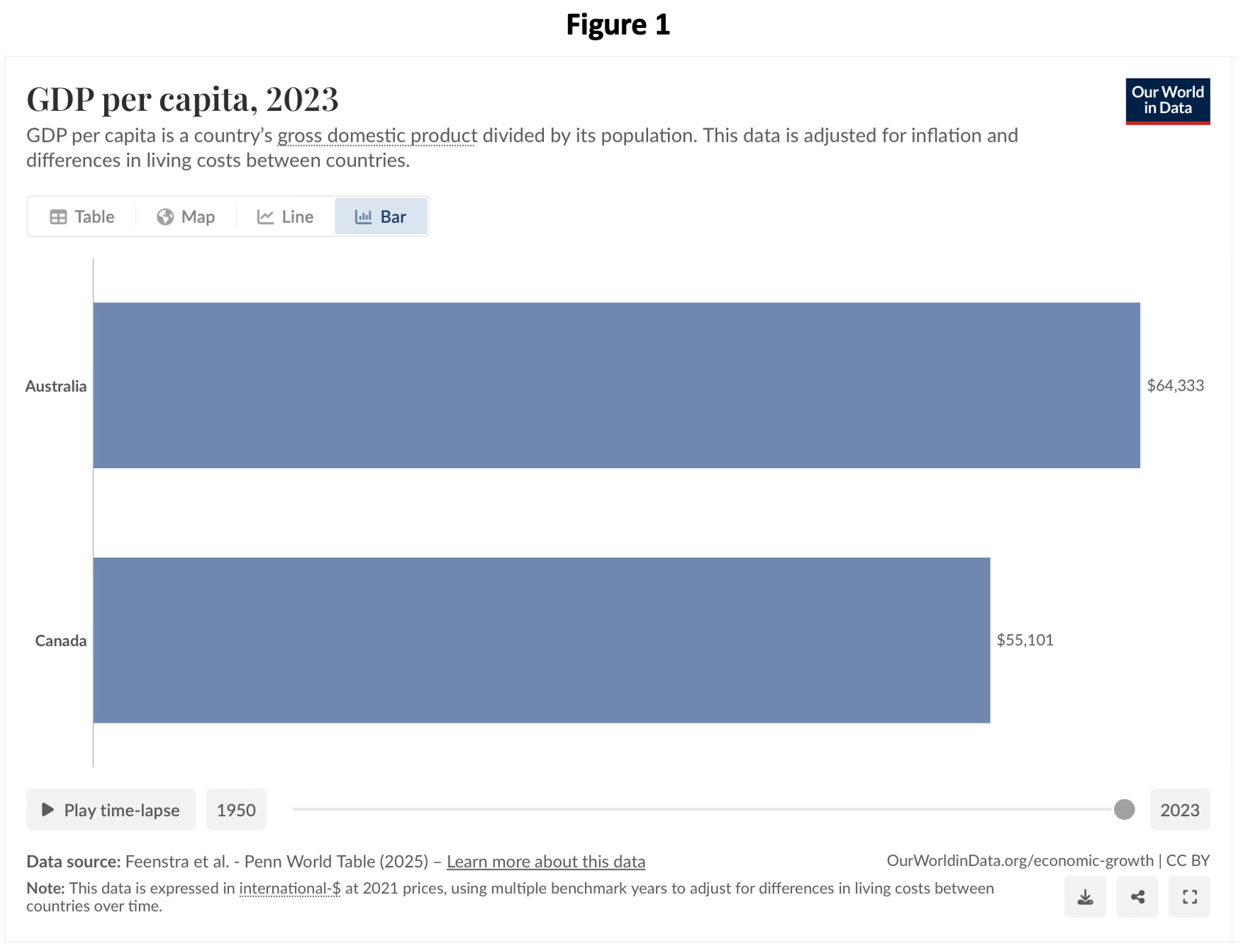
So, in the most recent year for which data is available in this series, Australia’s GDP per capita was 17 percent higher than Canada’s.[4]
That could be part of the explanation for a greater sense of optimism in Australia
But there is more to the story of the relative economic performance of the two countries. If we go back a quarter of a century, Canada’s GDP per capita exceeded Australia’s. Figure 2 below compares the GDP per capita for the entire period from 1990-2023.
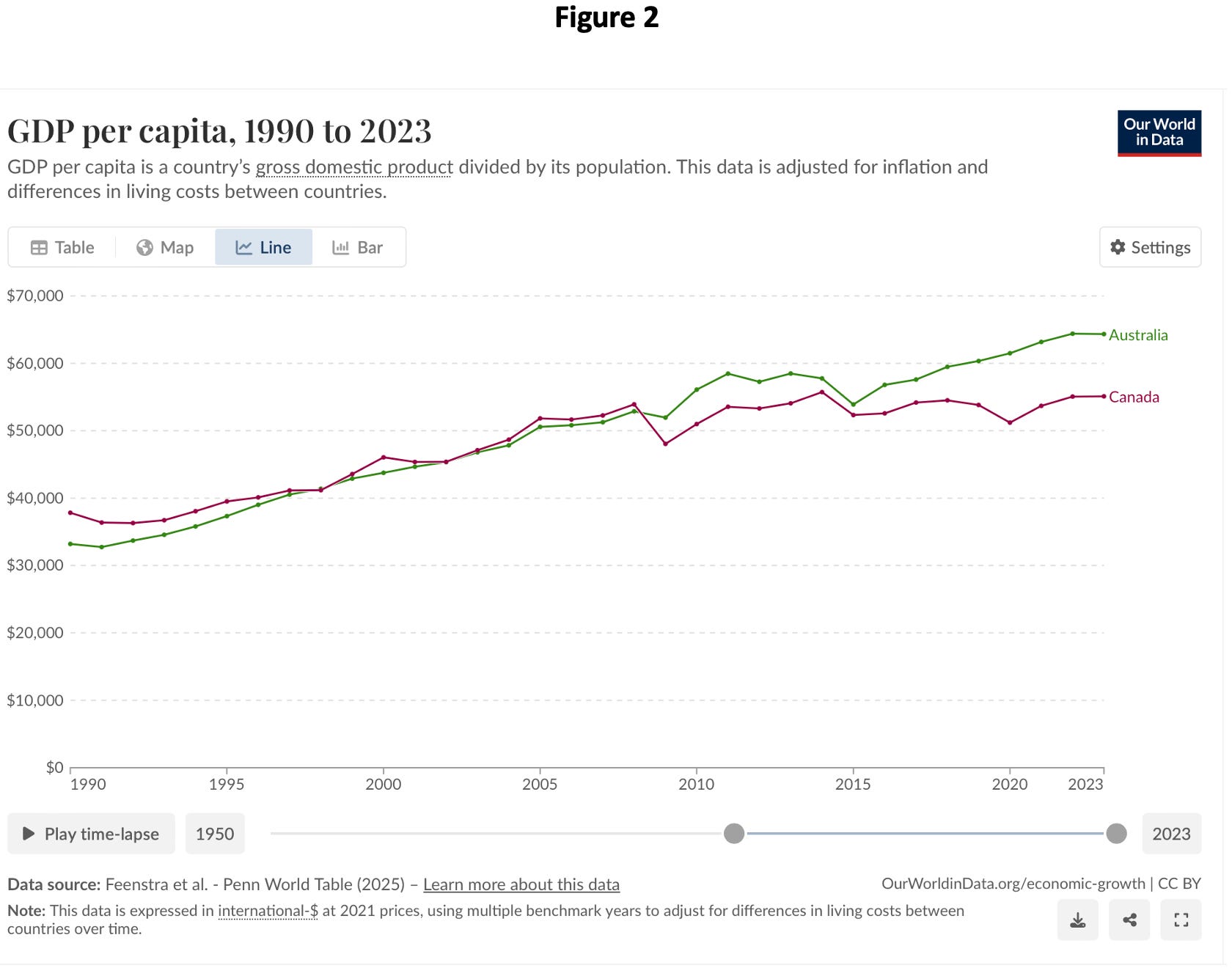
So, not only is Australia’s current GDP per capita higher than Canada’s, it has been growing at a higher rate than Canada for virtually all of the past quarter of a century. Had it grown at the same rate as Australia’s between 1990-2023, Canada’s GDP per capita would have been 33 percent higher in 2023 than it actually was. That represents a stunning reversal in relative economic performance.
Since 2014, there has been virtually no growth in Canada’s GDP per capita. In such circumstances, it is not at all surprising that Canadians sense of optimism and happiness has taken a bit of a dive.
Why the Dramatic Difference in Economic Performance Between Australia and Canada?
Australia’s economy is very similar to Canada’s in many ways. Both are relatively small in terms of the major economic powers, so the scope for achieving economies of scale based primarily on the domestic market will be limited. Both have been high immigration countries. Most significantly, both have high levels of natural resource wealth relative to the size of their populations. Not surprisingly then, each country’s economic base is heavily weighted to the export of natural-resource-based products.
It is in the latter factor that we see there has been a clear difference between Australia and Canada over the past quarter century. Australia seems to have been comfortable leaning into its natural resource wealth. Canada, not so much. To give a flavour of this, I looked at the growth in exports of natural-resource-based products since 1990. Figure 3 below shows the exports per capita, measured in 2022 US dollars, at eight-year intervals between 1990-2022.[5]
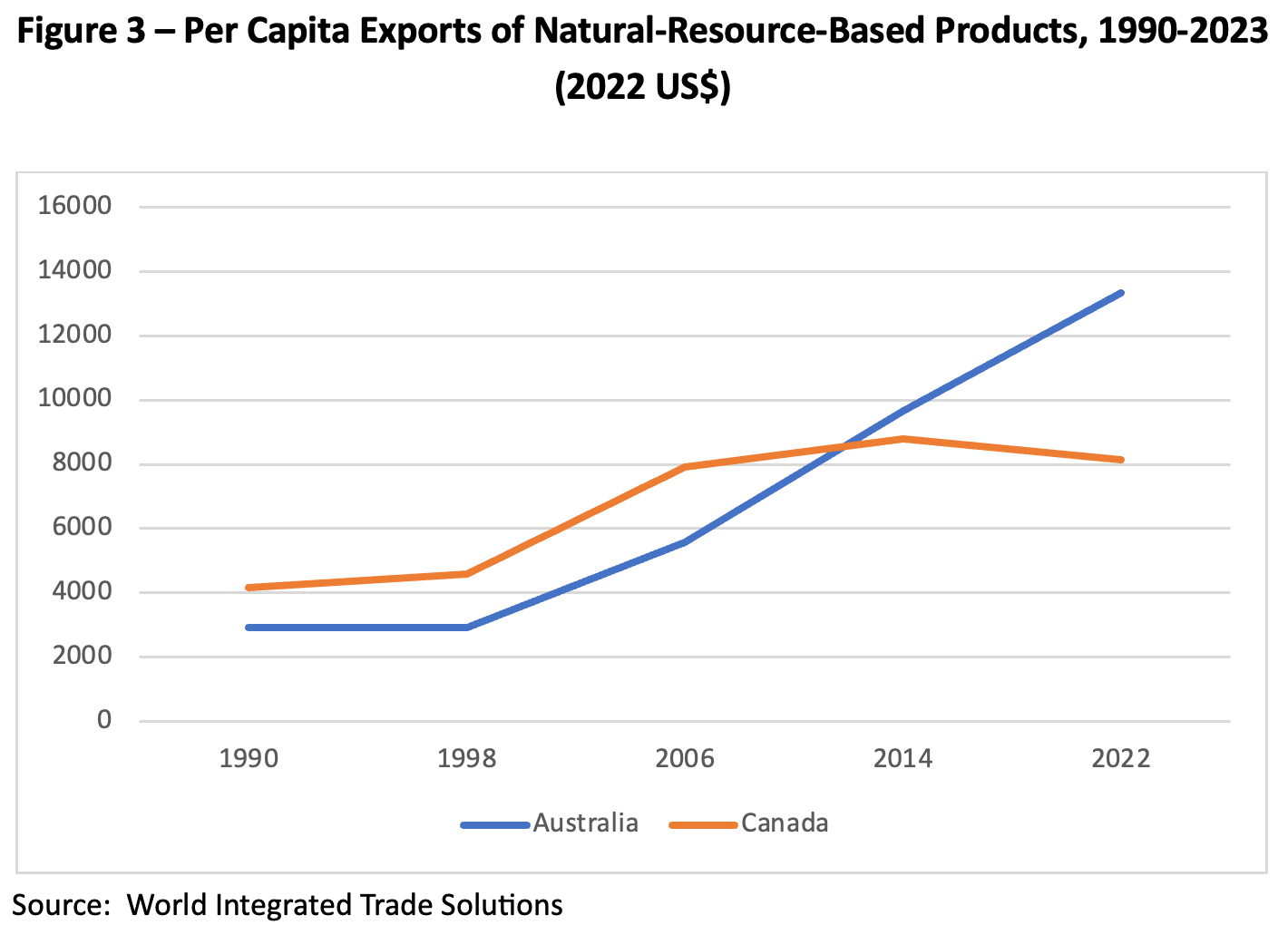
Canada initially had a higher level of per capita natural-resource-based exports than Australia, and this was maintained from 1990 through 2006. The rates of growth of these exports in that period were roughly the same. But after 2006 there was a dramatic slowdown in the rate of growth of Canada’s exports – in fact, per capita exports were actually lower in 2022 than they were in 2014. Australia, on the other hand, continued the rapid growth that had begun after 1998.
Why does this matter? It is just simple arithmetic. Jurisdictions with relatively rich endowments of natural resources benefit from a proportionately higher contribution of these industries to their standard of living – think of Norway, or, within Canada, Alberta. These industries tend to have higher GDP per employee, pay higher-than-average wages, and contribute higher-than-average net government revenue per employee. I discussed this basic arithmetic in a previous post.[6]
Compare the trajectories of the two countries in Figures 2 and 3. I am not saying that the relative difference in the growth in natural-resource-based exports is the only reason for the divergence in the growth of GDP per capita between the two countries. But it would stretch credulity to argue that there is no connection between the two.
Are There Lessons for Canada Here?
Since at least Harold Innis’ The Fur Trade in Canada in 1930 there has been an element in Canada’s chattering classes that have decried our role as “hewers of wood and drawers of water.”
I will forgo the opportunity to ruminate on the sociological, ideological and value factors behind this impulse. Except to note that it reached its political apogee with Prime Minister Trudeau at the 2016 World Economic Forum:
“My predecessor wanted you to know Canada for its resources. I want you to know Canadians for our resourcefulness.”
One should never devalue the resourcefulness of Canadians. But the implicit devaluation of our natural resources in that soundbite foreshadowed policies that very explicitly devalued Canada’s natural resource industries.
Canadians have borne a very significant cost from that.
Prime Minister Carney’s early moves – e.g. the first five “projects of national significance” designated include two mines and an LNG facility[7] - are a sign that we may be leaving that behind.
Here’s hoping.
[1] Previous posts on Iceland and Japan can be found at:
[2]
https://www.worldhappiness.report
[3] The extraordinary level of pessimism shown by young Canadians is not surprising in light of the evidence I marshalled in my first post back in May: https://donwright.substack.com/p/the-canadian-promise-is-broken?r=78jix
[4] Readers of the Iceland post will recall that there are other series that provide estimates of real GDP per capita for different countries over various time periods. The Maddison series and the World Bank series both show that Australia’s GDP per capita is higher than Canada’s for the most recent year in each series.
[5] Finding a data set that would provide figures that were consistently comparable between the two countries was a bit of a challenge. The data set used was found at World Integrated Trade Solutions, a project of the World Bank. https://wits.worldbank.org/about_wits.html . The data series was only complete up to 2022.
[6] https://donwright.substack.com/p/the-basic-arithmetic-of-canadas-standard?r=78jix
I travelled to Australia a few years ago and thoroughly enjoyed it. If I can, I would move there permanently. I too was confined by the length of our stay there to the east coast but it so reminded me of the Canada I grew up with….it felt safe and it felt that the governments were on the side of the people. I do not feel that way in Canada. But anyway, have enjoyed your travel blog Don and although I am not a graph person, I try to use your expertise to tweak up my knowledge…so thanks for that.
Like you, I have been in Sydney three times, and even worked there for several months, just over 40 years ago. I also wondered why I kept coming back to Canada. Thanks for the virtual update.