Grace Under Pressure

“Courage is grace under pressure”
Ernest Hemingway
I apologize for the paucity of my posts over the past two months. Due to some unexpected developments, I have not been able to find sufficient time for my regular posts. I expect that I will be able to resume posting quasi-regularly in the New Year.
Before breaking for the holiday season, however, I wanted to share one more post for 2025. This will be quite different than my previous posts. It will not have a direct connection to public policy. Rather, it is, I hope, a story that can inspire, in a time when I think we could all use some inspiration.
I want to tell you a little about a remarkable couple – Paul and Rav Thandi:
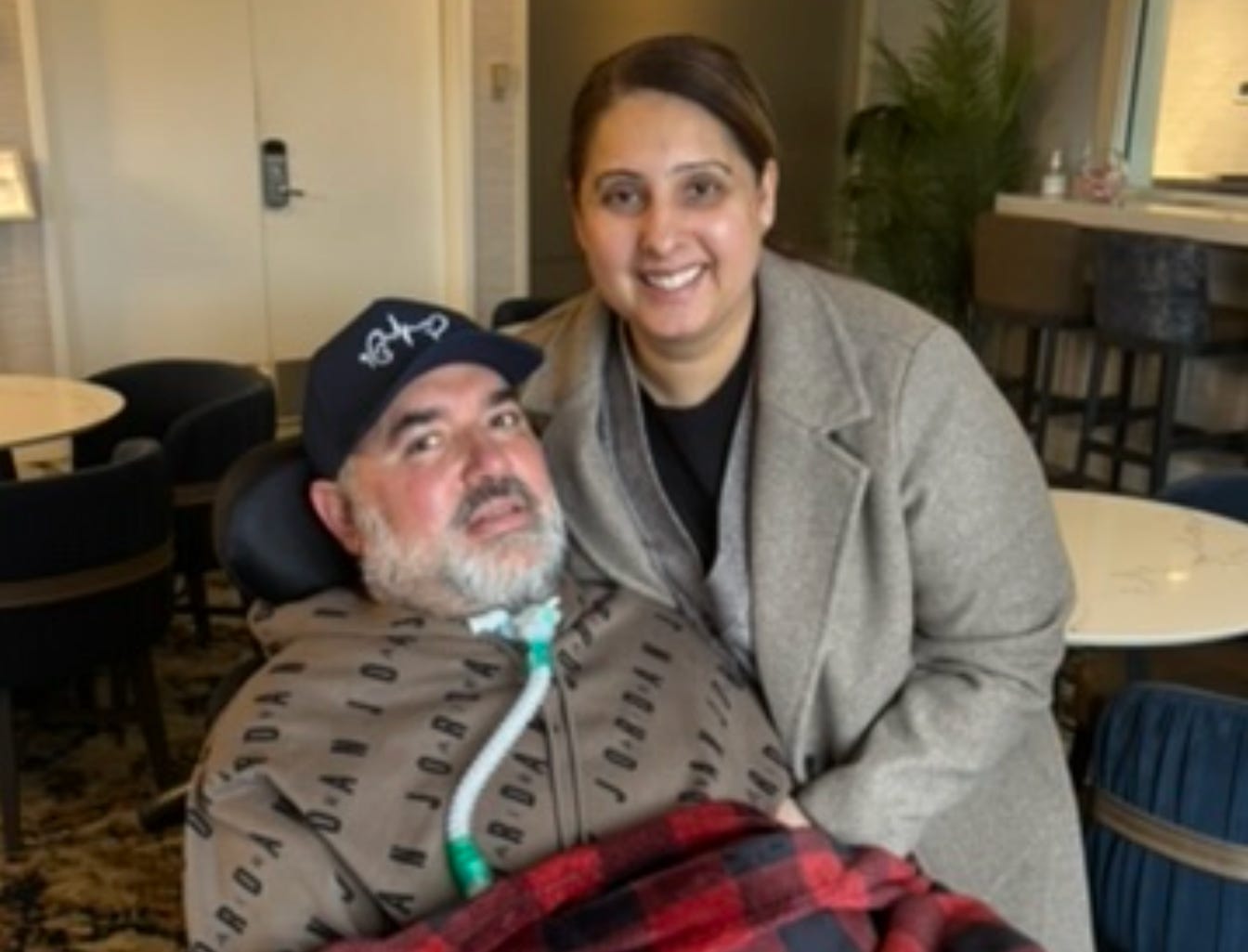
They started going out with each other when they were still in their teens, married in their early twenties, and have two children, now in their twenties. In addition to raising two children, they both had successful careers. They also made vital contributions to the social health of their communities – Paul, for example coached their kids’ sports teams. They were happily living a “normal” life.
Then, nine years ago, Paul was diagnosed with Amyotrophic Lateral Sclerosis (ALS). Rav says she still recalls being in the doctor’s office hearing the diagnosis as if it was yesterday – the memory is seared in her mind, as she knew that her life would be irrevocably changed by the news.
Paul sits on the Board of ALS Action Canada (ALSAC). ALSAC is a scrappy little non-profit set up five years ago by seven individuals that had just been diagnosed with ALS. When they realized there was little that the medical system could do to help them, they naturally became quite angry. But they decided to channel that anger into something positive, so they set up ALSAC to advocate for more research funding, greater access to clinical trials and speedier approval of new treatments. You can find out a little more about ALSAC here: https://www.alssuperfund.ca/als-action-canada-update
For the past four years I have had the privilege of serving on the ALSAC Board as Chair, and I have thus gotten to know Paul. Our meetings are, however, virtual. The virtual meeting platforms of Microsoft, Google and Zoom are wonderful ways to have meetings without the necessity of travel, and are a significant improvement over the conference telephone calls of just a few years ago. But they don’t allow for the important intangible benefits of meeting in person.
Three weeks ago, I had an opportunity to visit Paul at his home in North Delta, British Columba. And the week after that I was able to visit Paul and Rav when they were over in Victoria visiting their daughter. Before I describe what I learned from Paul and Rav, it is important to remind readers just how cruel a disease ALS is.
The Cruelty of ALS
There is currently no known cure for ALS – a diagnosis is a death sentence. On average, people with ALS (we refer to them as PALS) are gone within three years of their diagnosis. But the cruelty of the disease isn’t just the shortened life. ALS progressively robs PALS of their capacity to enjoy their remaining time. Their motor abilities – the ability to walk and to use their arms -are progressively degraded. They begin to have very serious breathing problems. Their ability to talk and be understood declines – I have watched a number of our Board members go over the course of just a few months from being able to talk articulately to the point where it is virtually impossible to understand what they are trying to say.
Many PALS choose, in consultation with their families, to avail themselves of the medical assistance in dying (MAID) option. I can only imagine the anguish with which they discuss this with their families, but a common theme emerges – they choose a point where they are no longer capable of enjoying any aspects of their life and where the burden on their loved ones becomes too great.
Paul and Rav’s Journey
Paul’s ALS path has been different than the average one described above in that he has survived much longer after his diagnosis than is typical. But otherwise, his path has been “typical.” In the first couple of years after his diagnosis, he was able to function more-or-less normally. But the diminishment of his physical capabilities has followed the typical pattern. He lost the ability to walk, and was confined to a wheelchair. He lost the ability to use his arms. He lost the ability to speak. A couple of years ago he had a tracheotomy so that he could breathe better.
From the very start of his journey, Paul was determined to squeeze every bit of a good life out of his remaining time.
One decision Paul and Rav made at the start was not to share the diagnosis with their two children until they could no longer hide it. At the time, both of the children were in high school, and Paul and Rav’s thinking was to let the children have a “normal” youth as long as possible – let them experience all of the challenges and joys of coming of age without the burden of knowing the prognosis for their father. Rav shared with me that, when they did tell their children about the diagnosis – when Paul’s symptoms could no longer be brushed off as “nothing to worry about” – both of the children expressed gratitude for being spared the news as long as possible.
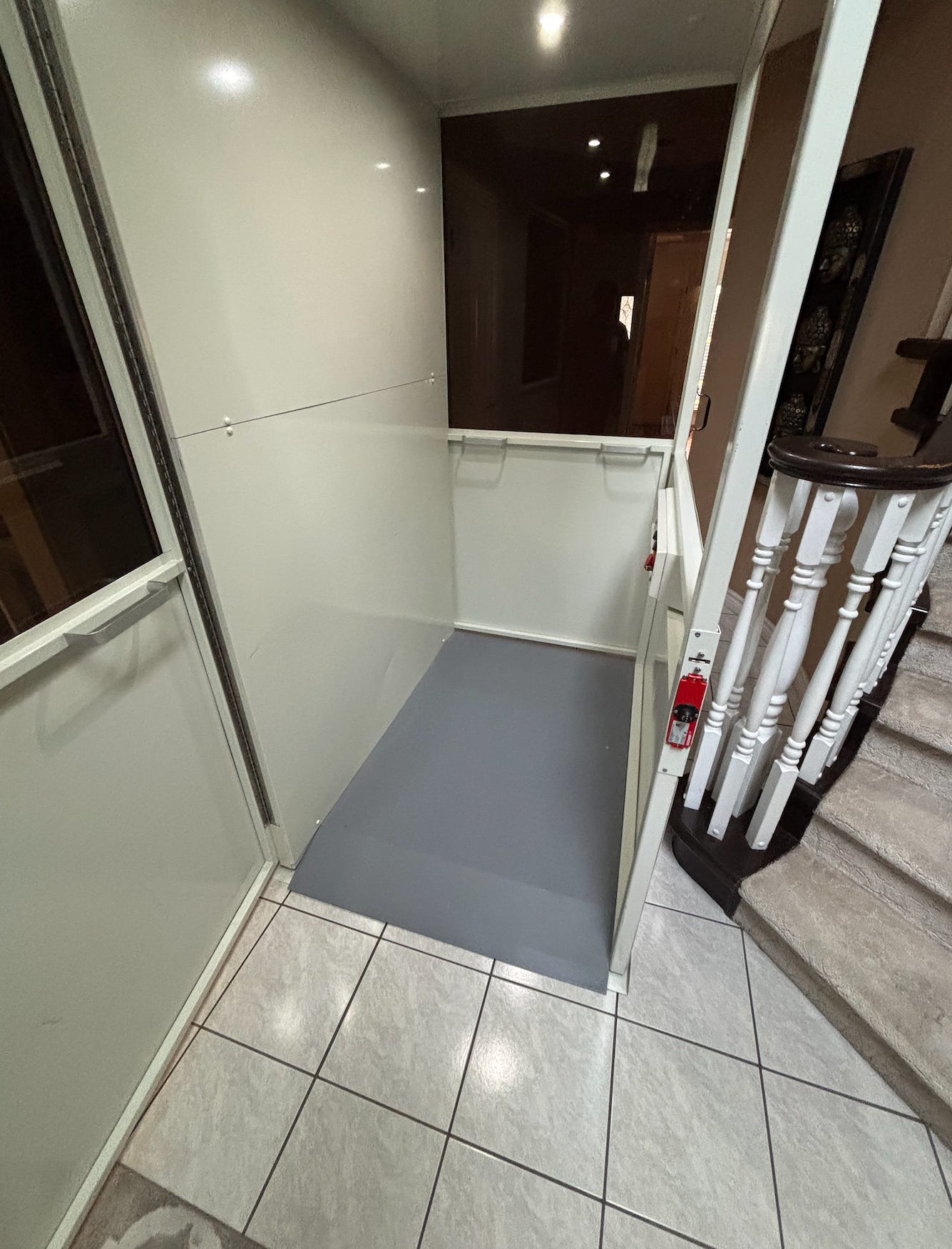
Paul has what I would describe as an “engineering mindset” – he is a real problem solver. He was determined to stay in their home as long as possible, while minimizing the burden that would fall on Rav. He did his research and began planning what renovations would be needed to facilitate that. He had an elevator installed so that he would be able to move between the upstairs and downstairs. Here is a picture I took of it:
Here is a picture of the bed Paul sleeps in:
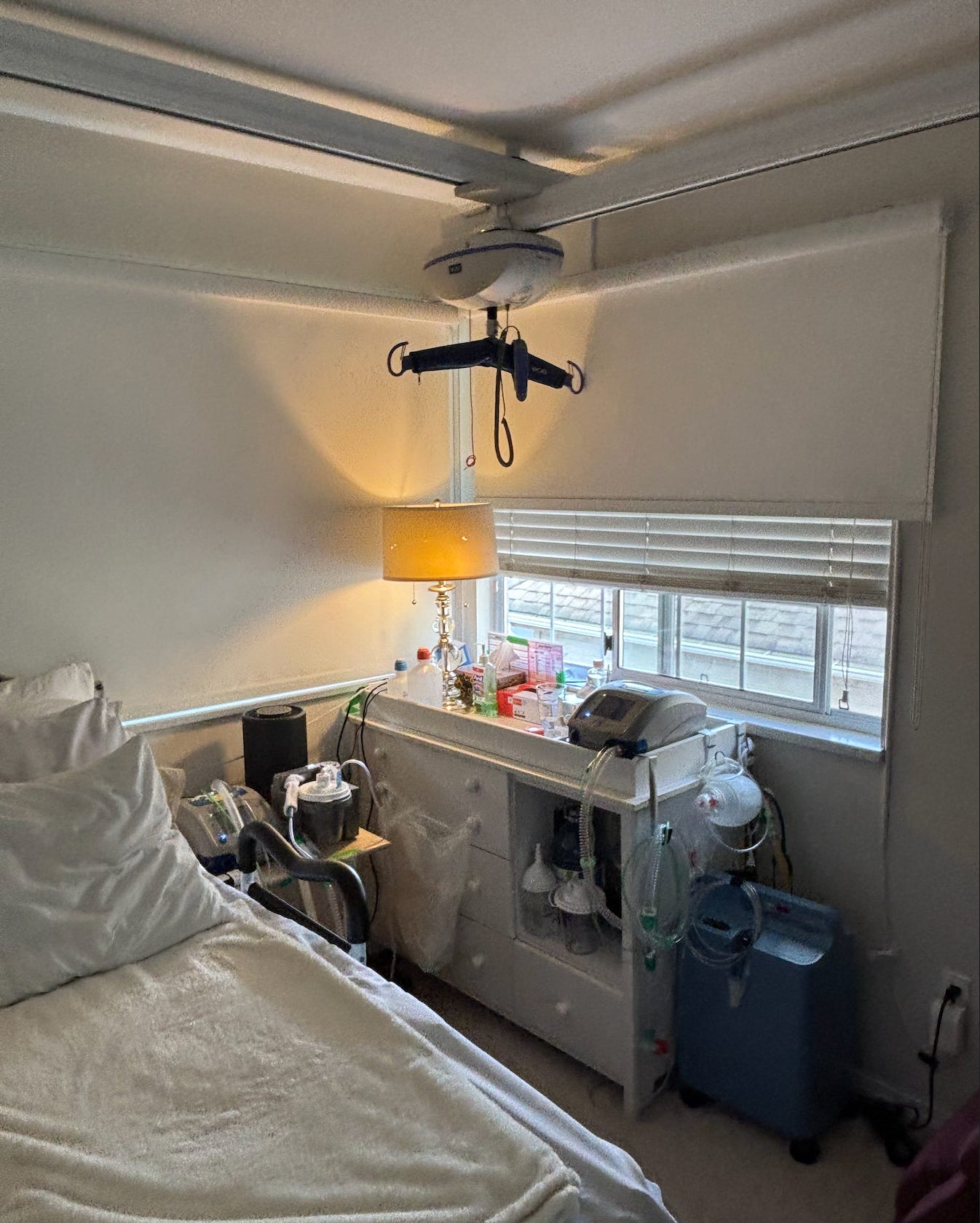
You can see some of his necessary equipment beside the bed. – e.g., ventilator. The apparatus at the top – vaguely egg-shaped, grey-coloured with black arms with loops extending below it – is a hoist that helps transport Paul to the bathroom in the middle of the night when necessary.
As I mentioned above, Paul lost the use of his arms and his ability to speak. But he hasn’t allowed that to eliminate his ability to communicate. He utilizes amazing eye-tracking technology that allows him to “type out” emails or engage in oral conversation. In the latter case, his “typed” messages are vocalized using “voiceprints” from recordings of his voice when he could still speak. Here is a short video that I took while visiting him. If you play it you will see how he is spelling out a message.
The most impressive bit of technology that Paul uses is something he has created himself. People with disabilities need a reliable way to request help when their caregivers are not in their immediate vicinity. The standard systems use a call button to send an audible, visual or vibrating alert to the caregiver. Here is a picture of what that the call button usually looks like:
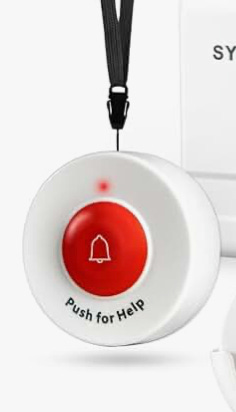
In Paul’s case, that wouldn’t work, because he would be unable to push the button.
Paul’s solution is ingenious. I regret not having taken a picture of it, so you will have to rely on my verbal description. The one movement Paul is still able to do is raise his eyebrows. So, he designed a device that is triggered when two tiny electrodes are brought together. He has his caregiver tape these electrodes to his forehead, one above the other and just slightly apart. When he raises his eyebrow, his brow furrows, bringing the two electrodes together, triggering the call button. When his caregiver showed me how this works he said, “Paul is brilliant.” I had to agree.
The Why
Impressed as I was by all of the engineering solutions Paul has managed to put together, what I found most moving was what Paul and Rav articulated in our conversations.
Paul told me that he wanted to change the way we think about what a diagnosis of ALS means. Yes, it currently is incurable, and there is only one way it will end. But he wants people to understand that, notwithstanding this, he and Rav still want to wring out as much of their life together as they can. They still have goals and dreams. And that was the reason behind all of Paul’s planning and engineering – to provide the greatest scope for achieving as many of those goals and dreams as possible.
I was too polite to get too nosey here, but I rather suspect that one of their key dreams is to see their two children flourishing. They were clearly quite proud of what their children have already achieved, and I recognized that fraught mixture of excitement and nervousness parents have when they contemplate their children’s futures.
The love and respect that Paul and Rav have for each other was palpable. Which made it all the more heartwarming when Rav told me they weren’t perfect. “We still disagree with each other. We still get mad at each other. We still fight from time-to-time.” (I have to admit, I wondered how the asymmetry in communication vehicles – Rav with her actual voice and Paul with his typed-out simulated voice – played out. Who had the advantage in that type of engagement?)
What Are the Lessons for the Rest of Us?
I stated above that I have had the privilege of sitting on the Board of ALS Action Canada. That’s because It has given me the opportunity to be inspired over and over by people like Paul and Rav. People that have been dealt just about the worst possible hand and have not let it defeat them.[1]
I have been extremely lucky in life (I am touching wood as I type that). Sure, there have been ups and downs along the way, but nothing that one could honestly label as real adversity. How would I have dealt with the type of news that Paul and Rav received nine years ago? I would like to think I would have shown the grace that they have displayed, but, honestly, I don’t know that for certain.
What I do know, is that we can all use a little perspective on the challenges we face, individually and collectively. Let’s not over catastrophize those challenges. Think of Paul and Rav.
Best wishes of the season to my readers. Thank you for your interest. We will pick up the conversation in the New Year.
[1] I have written a bit of a tribute to another ALSAC Board member – Mark Kirton, who we lost last summer. https://www.linkedin.com/posts/activity-7363411981665501185-fTkv?utm_source=share&utm_medium=member_desktop&rcm=ACoAAAKqgncB4i8cINPHb0m6GtkQiF-7vL4_Hxg
Your sister Nancy shared your lovely tribute with those of us in her book group, in memory of one of our book group members who passed away after 10 years living with ALS. She was a brave person, and she and her dear husband, who was her caregiver, exemplified grace under pressure. It is a dreadful and inexorable disease. Thank you for your service to the ALS organization and for sharing this couple’s story.
This is about the perfect reminder on so many levels of what is good around us. Thank for sharing Rav and Paul’s story Don.